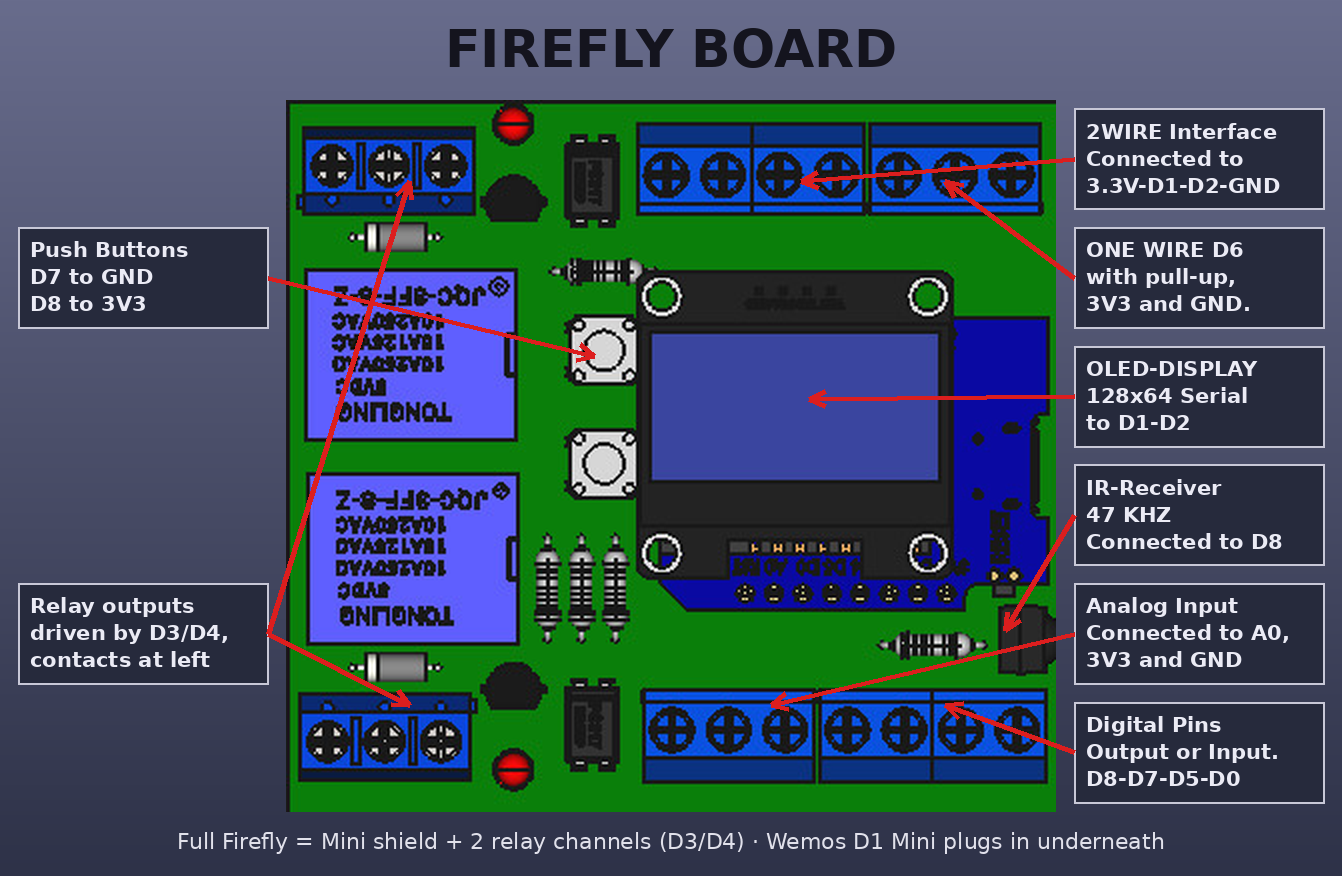
The full Firefly board is the Mini shield below plus two relay channels on D3 and D4. The Firefly Mini is the same shield without the relay modules — everything else on this page applies to both.
Board description:
Firefly is an advanced yet user-friendly platform designed to interface with various sensors and actuators using the Wemos D1 Mini board. The system is built to provide seamless integration and control through a web-based GUI, making it ideal for a wide range of applications, from home automation and DIY projects to scientific data logging.
Hardware Interface
The
Firefly system maps the pins of the Wemos D1 Mini board to screw
terminal connectors on the main board, providing easy access and
connectivity. The available connectors are:
• I2C Connector: A 4-way terminal block with +3.3V, SDA (D1), SCL (D2), and GND.
• OneWire Connector: A 3-way terminal block with +3.3V, ONEWIRE (D6), and GND.
• Analog Input Connector: A 3-way terminal block with +3.3V, AnalogIn (A0), and GND.
• Digital In/Out Connector: A 4-way terminal block with connections to D0, D5, D7, and D8.
• Relay Control: Pins D3 and D4 are connected to a 2-way relay board, with its contact terminals at the top-left and bottom-left of the board.
• Push Buttons: Pin D7 has a push button to GND, and Pin D8 has a push button to +3.3V.
• Display: A SSD1306 I2C OLED display header connected to D1 and D2.
Supported Sensors and Actuators
Firefly ships with a set of ready-made panel drivers you can mix and match on the board:
| Panel driver | What it does |
|---|---|
| Analog input | Reads any 0–3.3V analog sensor from the A0 terminal. |
| Digital input | Digital reading of buttons, switches and pulse sensors. |
| DS18B20 | OneWire temperature sensor. |
| BMP180 | I2C atmospheric pressure and temperature sensor. |
| Ultrasonic (HC-SR04) | Distance sensing for tanks, levels and clearances. |
| Flow / RPM counter | Hall pulse sensors for water flow and rotation speed. |
| HX711 | Load cells for weighing. |
| Digital output | Drive relays, LEDs and actuators. |
| Servo | Position any 0–180° servo motor (hardware PWM). |
Every input panel has calibration (offset/factor or two-point) and optional averaging built in.
The Firefly Mini board
Over the years, I’ve worked on countless electronics projects, often making my PCBs by hand and prototyping with breadboards and Dupont wires. One of the biggest headaches I faced was dealing with unreliable connections—whether it was sketchy PCBs or those pesky Dupont connectors that loosen after a few uses, causing intermittent issues. Living by the ocean added another challenge: corrosion, which only made things worse.
A few years ago, I noticed that many of my projects shared similar requirements. That’s when I decided to design a small PCB specifically for my Wemos D1 Mini projects. This board had several advantages: screw terminals for secure connections, a direct plug-in for an OLED display, two push buttons, an IR receiver, and support for a 2-channel 5V relay module. With this setup and the right firmware, I could build a variety of devices on the same board. Over time, that little board evolved into something much more versatile.
The Firefly Mini is a compact, reliable, and incredibly useful board that can simplify your projects and eliminate the frustrations of bad connections. I hope you find it as helpful as I have!
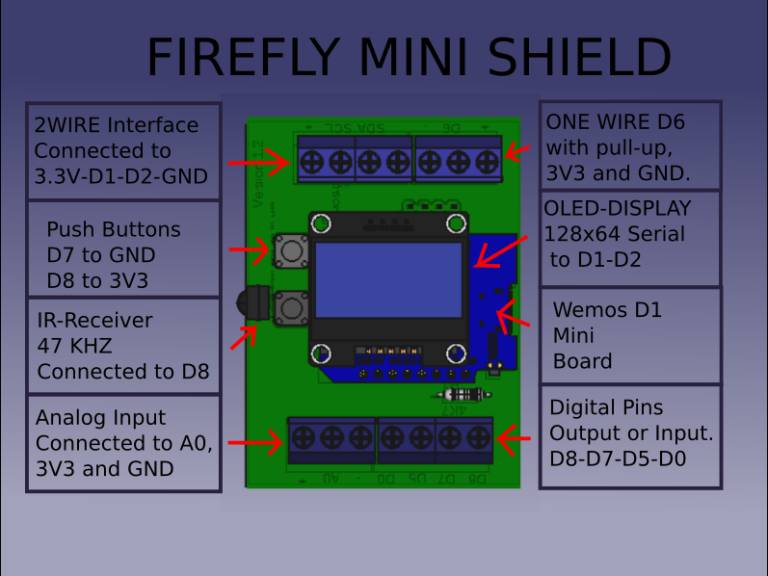
Description
The Firefly system maps the pins of the Wemos D1 Mini board to screw terminal connectors on the main board, providing easy access and connectivity. In addition it provides female connectors for a SSD1306 OLED display, 2 push buttons and an IR sensor.
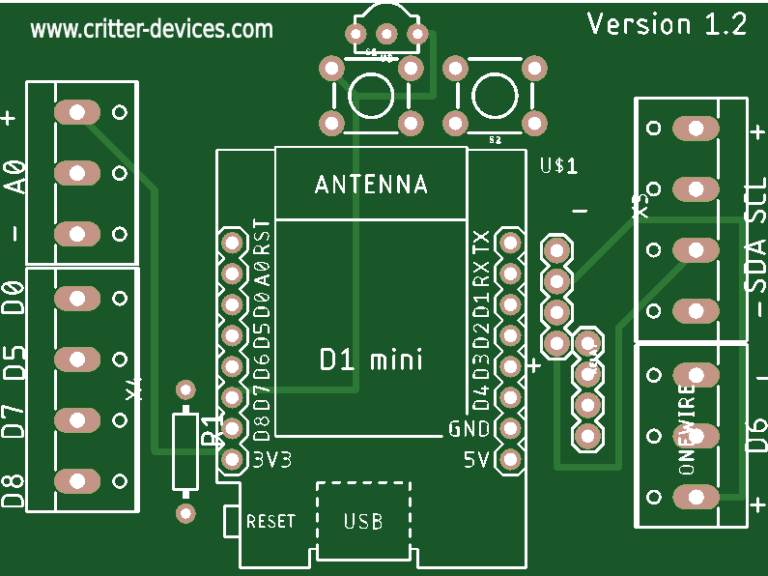
Firefly Mini PCB
This PCBs are very useful as they can be used for many projects and you don't need to populate all the components in every board, just as needed.
You don't need to populate the whole board. Solder only what the project calls for — sometimes that is a single terminal block on a bare PCB. A DS18B20 temperature probe, for example, needs just the OneWire terminals; an analog pressure sensor just the A0 terminals. Add the OLED header, buttons or relay pads later, only if the project grows into them.
I'm linking here the Eagle files in case you want to make them yourself. You can also get the PCB already made for you at the store.
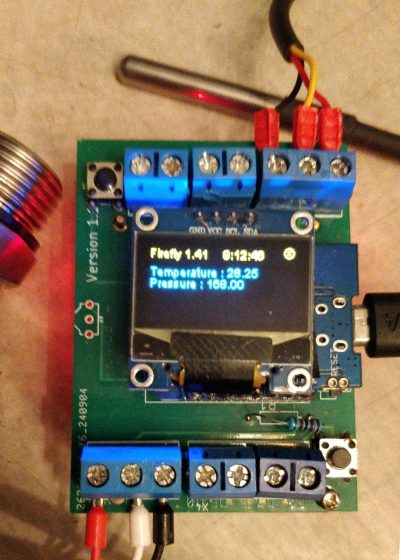
Example of application
The Mini runs the same open firmware and web dashboard as the full-size Firefly, so all panel drivers, the automation engine, data logging and MQTT/Home Assistant support work identically.
The picture shows a Firefly Mini with a analog pressure connected to the analog terminals ( bottom left ) and a DS18B20 temperature sensor connected to the onewire terminal ( top right )
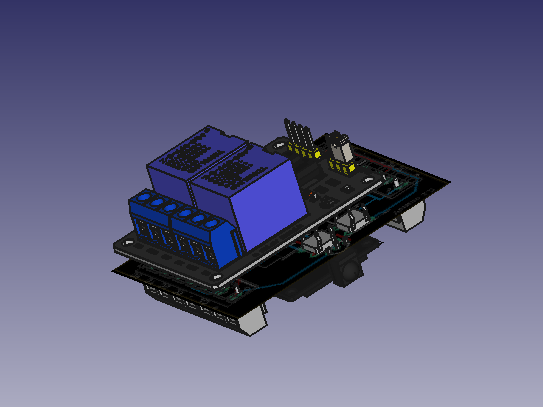
Relay Board View
One hidden feature of the Firefly Mini board is the possibility of attaching a 2 channel 5 volts relay board on the back of it. The relay board needs a slight modification to fit this configuration, it just involves heating up and pushing down the 4 input pins so they face the opposite side of the PCB and they can serve as a bridge between the 2 boards. The relay terminals are routed to pins D3 and D4.